
This is a div block with a Webflow interaction that will be triggered when the heading is in the view.
- Email signature marketing is the last untapped media channel.
- Ignoring it is like turning down free money.
- Even better, those ads would run with no other ads on the page.
- Many companies right now have the equivalent of a $200 advertising credit per employee per year.
- This credit I refer to sits in extremely prominent real estate at the bottom of your employees' emails - their email signature blocks.

Email signature marketing is the last untapped media channel. Ignoring it is like turning down free money.
What if I told you that I was going to give you a free Google display advertising credit of $200 for every employee? And that you could renew it every year? So if you were running a business with 500 employees, the company would receive $100,000 in free Google display ad credits.
That's over $100,000. Free. Even better, those ads would run with no other ads on the page. Zero competition.
Say what?
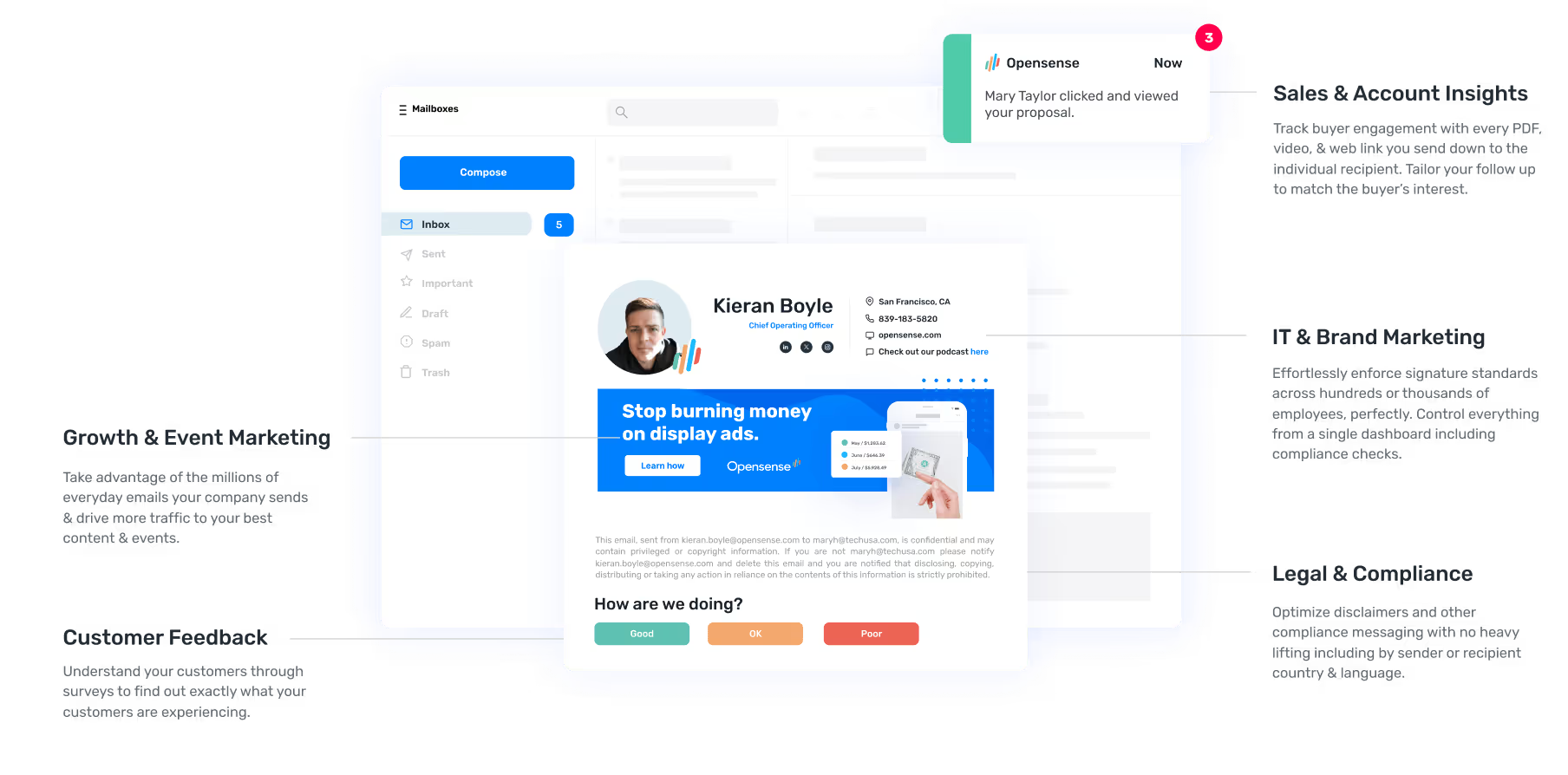
Most likely your marketing team would jump on that offer in a heartbeat. In fact, this is a true story. Many companies right now have the equivalent of a $200 advertising credit per employee per year. But it’s not in Google Display Ads or any other ad network. This credit I refer to sits in extremely prominent real estate at the bottom of your employees' emails - their email signature blocks. Signature blocks are HTML portions of emails that have all the same capabilities as rich digital advertising. But placement is guaranteed and the spots run on an owned media channel - your email stream.
Calculating The Monetary Value Of Your Email Signatures
You say, "How does that math work?" It’s pretty simple. According to the Radicati Group, the average employee sends 40 emails per day. Multiply that times the 261 working days in a calendar year in the U.S. (it’s might be less in other parts of the world) and you get 10,440 emails sent per year, per employee. Multiply that times 500 employees and you get 5,220,000 signature banner impressions. Considering how targeted these are and that you are running them with zero competition, this would be about the most premium CPM pricing you would pay on the open market, if not more.
That's because, when done right, these emails signatures are highly targeted, highly personalized marketing vehicles that are on par with or superior to any type of well-targeted display advertising. In cases where the email is not part of a marketing or sales effort, the recipient is still well targeted because they are likely in a field or company that is, at a minimum, tangentially related. In fact, rich, interactive signature banners in these emails could even be considered retargeted ads on steroids.
To be sure, the CPMs of display ads vary widely. But for targeted and expensive B2B segments or for highly competitive consumer areas (like real estate), CPMs often go well above $5 and can even go north of $20. (For some super niche sites, they can even be $100 and up!). So the simple math is to multiply the number of thousand emails times the CPM times the number of working days in a year to get a rough estimate of what the actual value of the email signature real estate is. And with that math, it’s pretty easy to justify an advertising value of $200+ per employee per year - or $100,000 in ad dollars for a 500 person company.
Why Signature Banners Are Better For Email Marketing
Now, you say that those emails may already have carried marketing messages. And that’s true. But those are text messages that take considerably longer to absorb and are less engaging. On mobile, reading text is more taxing than interacting with highly visual information like videos or colorful banners.
Additionally, text-centric marketing emails are not "smart". Sure, they can tell you how many times recipients click on links. But text emails cannot provide analytics on who watched videos or reviewed slide decks or read through PDFs. And text emails certainly can't tell you who spent how long on each piece of content, or what slide they viewed for the longest amount of time.
What’s more, email signature banners and marketing can publicize and pitch in ways that are relevant even if the text content of the email is focused on something else. For example, a marketing coordinator from a technology company who is emailing a friend in the field with questions about a report might still be interested in a white paper download or a relevant and engaging video in their friend’s email signature. (In fact, they might even be more interested precisely becomes it comes from a trusted source).
Put Your Marketing Messages In A Trusted, Owned Channel
Because this is the real truth. Emails remain the most trusted B2B person-to-person communication channel that also has valuable real estate. We all pay big dollars to advertising networks that devote massive amounts of resources to ensuring that they place our spots against relevant audiences (and right alongside our competitors, most of the time).
Roughly one-third of people today are running ad blockers. And it is nearly impossible to guarantee that a display ad served over a display network was actually seen -- or even was visible! This is particularly true on mobile devices.
So the reality is, the most relevant marketing audience of all is right under our noses - and they are freely accessible. They are reading our emails because emails convey useful information. Like two $100 bills that we find on the side of the road, this audience is a gift from heaven. In an era when advertising is increasingly expensive, noisy and ineffective, email signature marketing looks almost too good to be true.
So what are you waiting for? Get your banner ads running in your signatures. And collect your free money. Or you can wait and watch money go out the door this week alone. Your choice.
Bobby Narang is the VP of Sales at Opensense. He can personally attest to the value of email signature marketing in helping him close deals (although he's a bit biased).