
This is a div block with a Webflow interaction that will be triggered when the heading is in the view.
- Myth 1: “Daily Stats Matter” Although this isn’t necessarily preached upon, there’s a dominant view that daily stats matter.
- You check your inbox to see how many emails there are left to respond to.
- Regardless of what space you’re in, the web is flooded with plenty of blogs like this one that addresses points that everyone should agree with.
- Claims are meant to be proven wrong, and arguments are meant to have counterarguments.
- In this article, I want to share three claims I’ve seen in growth marketing and how my journey has contradicted them.

Regardless of what space you’re in, the web is flooded with plenty of blogs like this one that addresses points that everyone should agree with.
Let’s call it for what it is: dogma.
Whether it’s the classic example of wanting a better horse and buggy instead of a car or self-help authors preaching that the habit is the way, just because it works for the writer doesn’t mean that it works for everyone.
Claims are meant to be proven wrong, and arguments are meant to have counterarguments.
In this article, I want to share three claims I’ve seen in growth marketing and how my journey has contradicted them.
Myth 1: “Daily Stats Matter”
Although this isn’t necessarily preached upon, there’s a dominant view that daily stats matter. We don’t say it out loud but we perform it with our behavior.
You check your notifications on LinkedIn once a day to see if anyone liked your post or viewed your profile. You check your inbox to see how many emails there are left to respond to.
You, the reader, may not engage in these exact behaviors. Yet it is true that the culture is wired to the daily notification.
It’s hard to resist checking stats on SEO and social media engagement every day but it’s something that growth marketers can start doing to be at peace with themselves.
I should know.
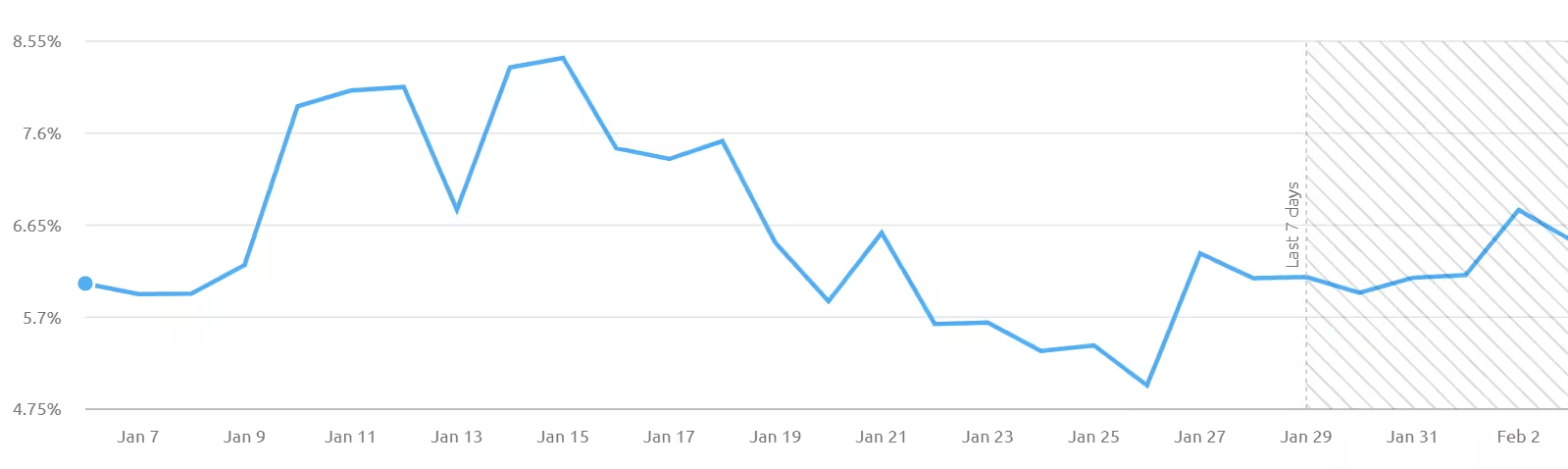
At SalesPipe, we recently took a hit in keyword rankings on the SERPs and the trough went from 8% keyword visibility down to 4% in just one week.
Our impressions on Google went down as well. We went from having over two-thousand impressions to below 1,500 a day.
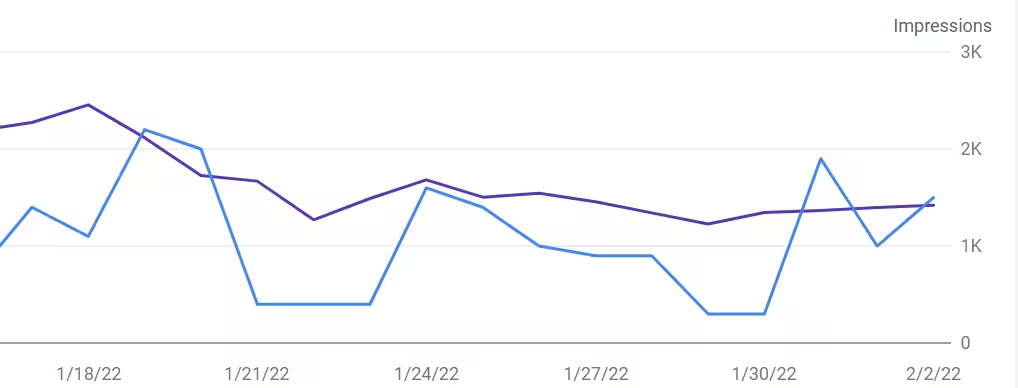
The trough of keyword rankings happened greatly on one day and subtly declined for another week. We waited that week before doing anything. We fixed a technical issue that may or may not be relevant (updated site maps). Our keywords started coming back up after the short trough around January 26th.
It was alarming to us when it first happened and we wondered how we could fix it. At the end of the day, though, putting content on any platform powered by algorithms out of our control and having expectations of stability is not a combination for success.
All we could do is what was in our control.
Who knows if updating and removing site maps had any effect? After all, Google’s algorithm changes over 4,000 times in some years.
Plus, daily stats don’t matter as much as the aggregate does.
If the problem keeps on happening, then that’s when we should investigate the numbers and see what’s going on.
Do you check your weight daily? No.
Don’t check your growth marketing stats daily either.
Things take time to happen and we only have so much authority to control the outcome.
Myth 2: “Write Content Everyday”
I don’t write content every day.
My focus as a growth marketer is mainly SEO and LinkedIn. There are tons of content creators on both Google and LinkedIn, all trying to be at the top of peoples’ SERPs and feeds.
But writing content every day isn’t going to convince the overloaded social media user to read what I wrote.
Instead, having a deliberate focus on content quality does that.
Imagine you are ordering a large fry from McDonald’s. You aren’t that hungry, but you order a large one anyway. Why are you doing that?
Because they’re good!
The same thing can be applied to content.
When I read one piece of amazing content on LinkedIn, I usually either keep on reading new posts or read more posts from the same person if they have any. I only stop when I get busy or when I get bored.
Bad content makes me bored.
Wouldn’t the world be better off if it comprised of less but better content than the opposite?
I think so.
That’s why at SalesPipe we don’t even have twenty blog posts on our site. We rank high for our most important keywords because the content we’ve made for those keywords serves those who want to read it.
You don’t eat more fries because they’re fries. You eat them because they’re good fries.
The same goes for content.
Less is more.
Myth 3: “Be On Every Platform”
This is a myth I never believed even before I started working in growth marketing.
Related to the previous myth, there’s so much content already that only so much of it gets read. Wouldn’t it be logical, then, to not only create as much content as possible but to also do that strategy on every platform?
If you have all the time and the resources to do that and make the content stellar, great.
Unfortunately, unicorns don’t exist.
Our customer at SalesPipe, sales executives and founders who need outbound SDRs, don’t use Facebook, Instagram, or TikTok to search for what we sell.
But they search for “SDR as a service” on Google.

Some of them are also pretty active on LinkedIn.
Rather than trying to be on every platform, the better strategy is to identify which platforms your customers live on and then create content that they will engage with.
Conclusion
Despite this not being a research paper, I have a thesis for this article: quality over quantity. Growth does not equal numbers.
Growth marketers should focus more on doing that than the myths. I promise you won’t regret it.